New York opens RAISE Act registration: $500 million revenue, 10^26 FLOPs, 72-hour incident reports and a January 1 deadline
The first US state registry of frontier AI developers is now taking filings; here is who is covered, what they must publish, what the penalties are and how it differs from California's SB 53.
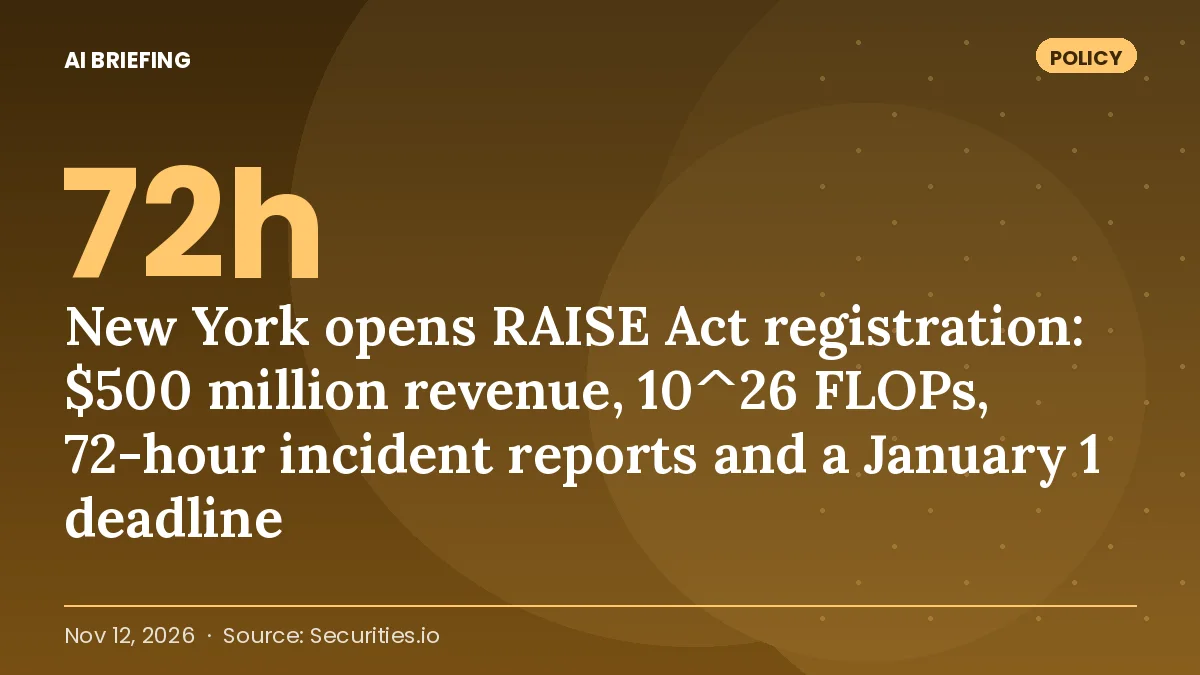
Governor Kathy Hochul announced on November 10 that registration is open for large frontier developers under New York's Responsible AI Safety and Education Act, signed in December 2025 and in force from January 1, 2027. The announcement came with the launch of the New York Center for AI Responsibility and Research at Binghamton University, which will help review the safety frameworks the law requires companies to publish. New York is the first state to run a registry of frontier developers; California's SB 53 imposes similar transparency duties without one.
Who is covered
A frontier model is one trained with more than 10^26 integer or floating-point operations. A large frontier developer is a company whose annual gross revenue, with affiliates, exceeded $500 million in the preceding calendar year and that develops, deploys or operates such a model wholly or partly in New York. Accredited colleges doing academic research and the state's Empire AI consortium are exempt. Fine-tuning someone else's frontier model does not make you a developer, and nothing applies below the revenue line, so the registry will hold a handful of names: OpenAI, Anthropic, Google, Meta, Microsoft, Amazon, xAI's successor entities and a few others.
What they must file and publish
Registration goes to DIGIT, the Office of Digital Innovation, Governance, Integrity and Trust inside the Department of Financial Services, with business names and addresses, three regulatory contacts and specified beneficial owners. DFS publishes the list of registrants, minus the contacts, and assesses developers pro rata to fund its costs. Renewal is due every two years, on any transfer of model ownership or on a material change, whichever comes first. Each developer must write, implement and publish a frontier AI framework, review it at least annually and publish material changes within 30 days. Before or alongside deploying a new or substantially modified model it must publish a transparency report. Redactions must be justified and the unredacted text kept for five years. Critical safety incidents must be reported to DIGIT within 72 hours, incidents that pose imminent risk of death or serious physical injury to law enforcement within 24, and summaries of catastrophic-risk assessments from internal model use filed confidentially every three months unless DIGIT approves another schedule. Catastrophic risk means a foreseeable, material risk of more than 50 deaths or serious injuries or more than $1 billion of damage from a single incident.
Penalties
The attorney general can seek civil penalties of up to $1 million for a first specified violation and up to $3 million for each subsequent one. DIGIT can separately impose $1,000 a day, after notice and a hearing, for failing to file a registration disclosure or correct false information, plus unpaid assessments.
How it compares with California
California's SB 53 covers roughly the same companies and requires a published framework and incident reporting to the state's Office of Emergency Services, with whistleblower protections New York's law lacks. It has no registry, no assessment fee and no quarterly internal-use filings, and its penalty cap is $1 million per violation. The Future of Privacy Forum's comparison notes the clocks differ most: SB 53 allows 15 days to report an incident, RAISE 72 hours from a reasonable belief that one occurred, which is the practical burden: a lab must now run two reporting pipelines with different triggers, and a federal pre-emption bill remains stalled.
The counter-argument
The thresholds mean the law touches perhaps ten companies, two of which, Anthropic and OpenAI, are entering or planning IPO quiet periods that limit what they say publicly; a published safety framework reviewed by a state-funded centre is a new liability surface in a securities filing. Critics also note that a $3 million penalty is immaterial to companies with quarterly revenue above $10 billion, and that the research centre, with $55 million of initial funding and no access to unreleased models, can review documents but not systems.
What to watch
The first names on DFS's public registry in January; whether any lab argues it does not operate 'partly in New York'; the first 72-hour incident filing and whether DIGIT publishes it; how the quarterly internal-use summaries interact with Anthropic's S-1 warning that it may soon meet its own threshold for AI-accelerated research; and whether other states copy the registry model, since a filing regime, unlike a transparency duty, produces a list.
More in Policy & regulation
All →
Australia's AI safety regulator: mandatory incident reporting, penalties and model evaluation after the Medicare breach
The first Western government to answer a specific AI-agent incident with a statutory regulator has set a template other capitals will copy; the detail…
After the midterms, the data-center backlash has votes behind it
Local measures against new AI data centers won across several states this week. The industry's response, from paying for its own power to warning of s…
The PATIENT AI Act draft: a third-party FDA review path and a Medicare pathway, comments due December 1
Senator Cassidy's discussion draft is the first serious attempt to legislate how clinical AI gets reviewed and paid for. FDA lawyers say the review ti…
Get the brief in your inbox
One email every morning: the stories that mattered in AI, each with a one-line "why it matters" for your role. Free, no ads, unsubscribe any time.
Published daily by AI Briefing. We never share your address.