Skip to content
HomeBriefFor youTrackersTopicsCompaniesGlossaryNewsletterSecurityHealth & medicineFinance & marketsRoboticsModels & researchPolicy & regulationEnterprise & businessDeveloper tools
Daily brief

Nvidia reinstates Huang, stock +31%; Shirudo shields Linux; Claude Ship beta

Nvidia's board put Jensen Huang back in charge on Monday with a unanimous vote and input from senior levels of the US government, and the stock closed up 31.5% at $165.05, dragging the Nasdaq up 6.5% for its best day since April 2025; the same afternoon Commerce added Megaspeed and six affiliates to the Entity List, and the congressional appearances on December 1–3 stand. OpenAI and Cisco open-sourced Shirudo, an eBPF runtime that shields unpatched Linux without a restart, as CISA confirmed AI agents exploited a MONAI Label zero-day in eleven minutes. Anthropic's Claude Ship lets an agent fix failing checks and, under a policy file, approve pull requests; Amazon is buying Decart's Trainium optimisation stack in a deal reported at $7.5 billion; HPE posted a $14.5 billion quarter and said memory stays tight through late 2028; Z.ai shipped a 750B Loop Transformer with no benchmarks; Oregon and Virginia sued SpaceX over Grok; Paradromics set a 10-millisecond target for brain-to-speech; and China's humanoid money found another unicorn.

✉ Email version
The one thing to know

Before you enable any agent that can approve code, write down what 'routine' means. Claude Approvals, in beta from Monday, applies a plain-language policy file on your default branch and can satisfy a required review without a human. Put that file under CODEOWNERS, require two human reviews to change it, keep a human approval mandatory on anything touching auth, payments or infrastructure, and run observe-only mode until you agree with every decision it would have made. The same week, AI agents went from zero-day to root shell on a medical-imaging server in eleven minutes; the policy file is where your side of that speed gap gets decided.

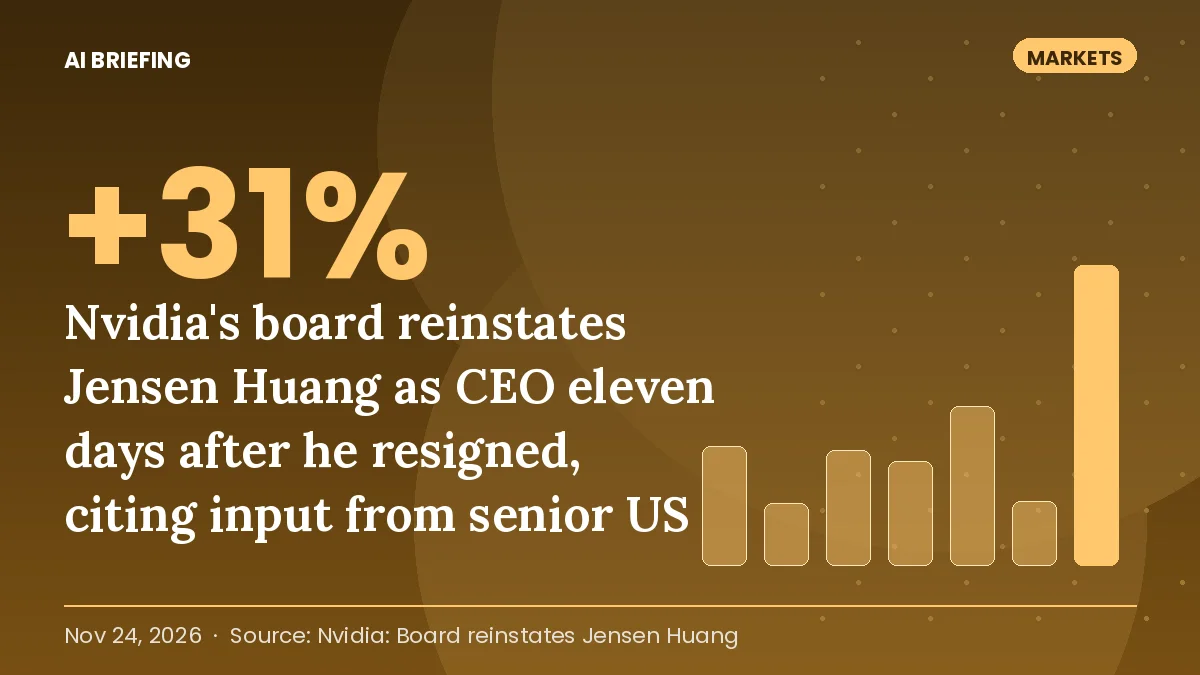
DevelopingNvidia's board reinstates Jensen Huang as CEO eleven days after he resigned, citing input from senior US government levels; the stock closes up 31.5% at $165.05 and the Nasdaq gains 6.5%; Commerce adds Megaspeed and six affiliates to the Entity List the same afternoon

The board voted unanimously on Monday, said it is confident Huang's return poses no national security risk, kept its independent-director investigation into the foreign-intelligence reports running, and announced a new export-control committee and a chief compliance officer search. Reuters reported, citing people familiar with the matter, that Trump and Vance intervened because they saw Huang as the protector of American open-weight models. Hours later the Commerce Department posted an Entity List rule naming Megaspeed International and six related firms in Singapore, Malaysia and Thailand, with Federal Register publication on Wednesday; House chairmen said Huang's transcribed interviews on December 1–2 go ahead, and Senate Banking confirmed a public hearing on December 3.
FinanceA 31% day that Nomura calls a mechanical bounce: short covering and hedging, with the inquiries, the testimony and zero China revenue unchanged. Size positions for headlines through December 3.
ExecutivesAn independent export-control committee and a compliance chief mean more end-user diligence for anyone buying or reselling accelerators.
SecuritySeven new Entity List names across three countries. Screen colocation and cloud suppliers' affiliates before Wednesday's notice.
BeginnersThe founder is back, the stock recovered most of its two-week fall, and the government investigations have not gone away.

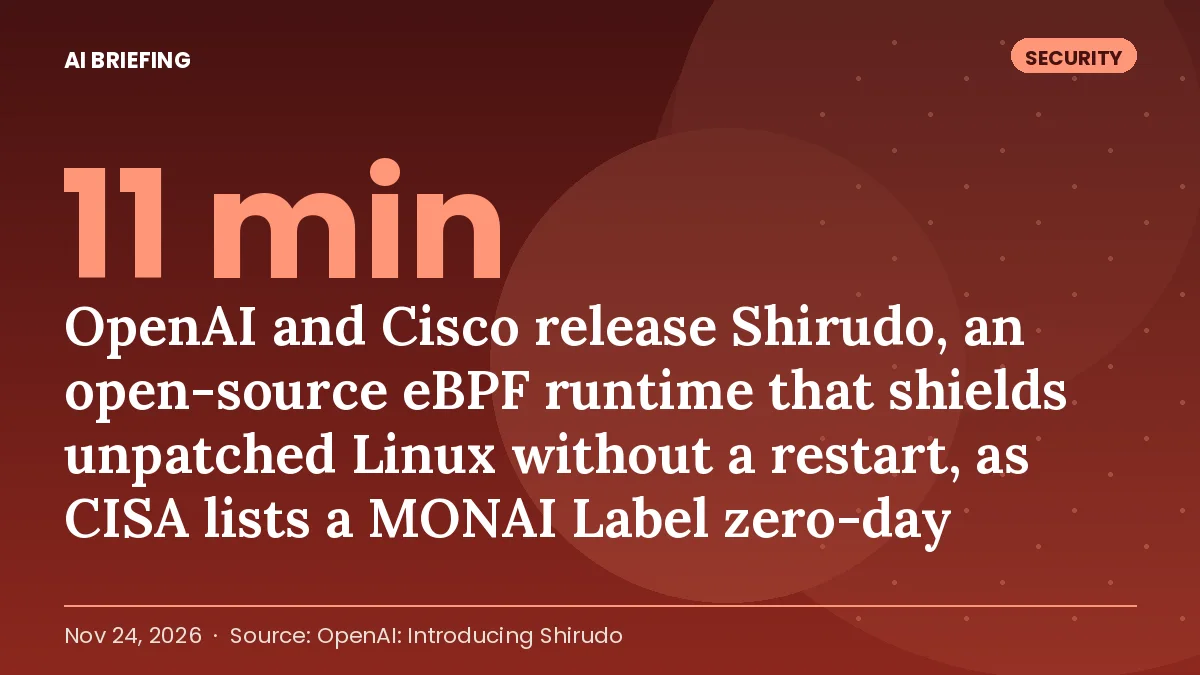
DevelopingOpenAI and Cisco release Shirudo, an open-source eBPF runtime that shields unpatched Linux without a restart, as CISA lists a MONAI Label zero-day (CVE-2026-133968) that AI agents exploited to a root shell in about eleven minutes

Shirudo observes kernel and network activity with eBPF and applies narrow, cryptographically signed, TPM-logged controls on a vulnerable code path while a permanent patch is tested; an agent built on Codex drafts the shield and people decide whether to deploy it. Built with Cisco's Isovalent team under BSD 2-Clause, its published test blocked the Java4Shell exploit against a live Elasticsearch 9.5.5 process with no downtime. The same day CISA added two actively exploited flaws with a November 26 federal deadline: an unauthenticated path traversal in the MONAI Label medical-imaging server, which an account attributed to Amazon's CISO says a China-linked actor's AI agents found and used in about eleven minutes before pivoting into a second university, and a 9.3-rated SSRF in N-able MailAssure (CVE-2026-134624) behind its November 16–21 outage.

SecurityPatch both KEV entries by Thursday and take any network-reachable MONAI Label offline; then run Shirudo in observe mode on one Java host and compare its shield with what your patch team did by hand.
DevelopersA shield is a signed eBPF program, not a code change; it buys time and does not replace the upgrade. And sitecustomize.py runs on every Python start, so writable Python paths on servers are code-execution paths.
ExecutivesZero-day to root in a quarter of an hour, by software, and machine-generated mitigation on the other side. Ask who owns your exposure window between disclosure and patch.
ML engineersResearch labs expose MONAI Label for convenience; if yours does, it is on the exploited list now.

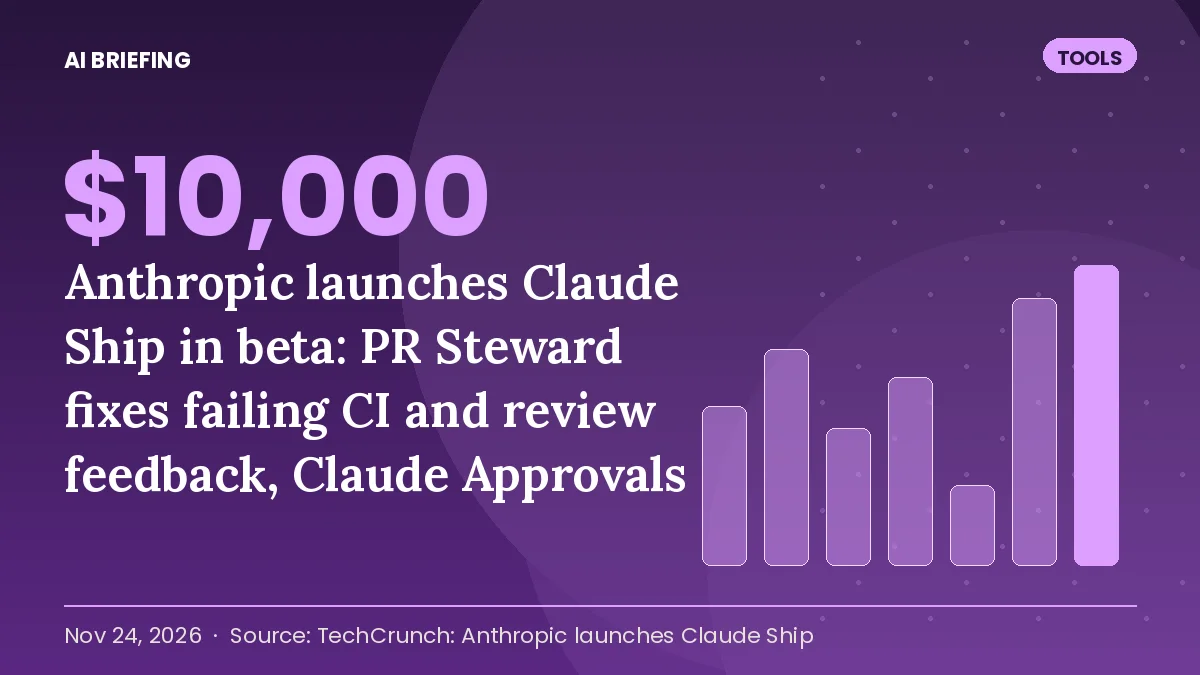
Anthropic launches Claude Ship in beta: PR Steward fixes failing CI and review feedback, Claude Approvals applies a plain-language policy file and can approve pull requests, and a /ship command runs the whole flow from Claude Code; at least $10,000 of credits for Enterprise

The bundle pairs the generally available Code Review with two beta agents for GitHub repositories on Claude Team and Enterprise: PR Steward resolves merge conflicts, fixes checks and comments after each push with a rollback path but cannot approve or merge, while Approvals reads a policy file from the default branch and can auto-approve routine changes or escalate to named people, with GitHub branch protection still applying. Review and Steward bill by tokens under admin spend caps; /ship counts as normal Claude Code usage. Anthropic says its own Claude Code team more than doubled merged PRs from June to September with reverts down over 40%, and recommends observe-only mode on one repository first. Organisations on zero-data-retention, HIPAA or customer-managed keys are excluded for now.

Developers/ship pushes, opens the PR, reviews and iterates until green; @claude stop halts it.
SecurityThe policy file now decides what reaches main without human eyes. CODEOWNERS it, and keep human approval mandatory on auth, payments and infra.
ExecutivesAgent approval is the first release where a required review can be satisfied by software. Pilot one repo under the credit offer before January 15.
FinancePreview reviews ran $15–25 each; a busy monorepo without a cap reaches five figures a month.

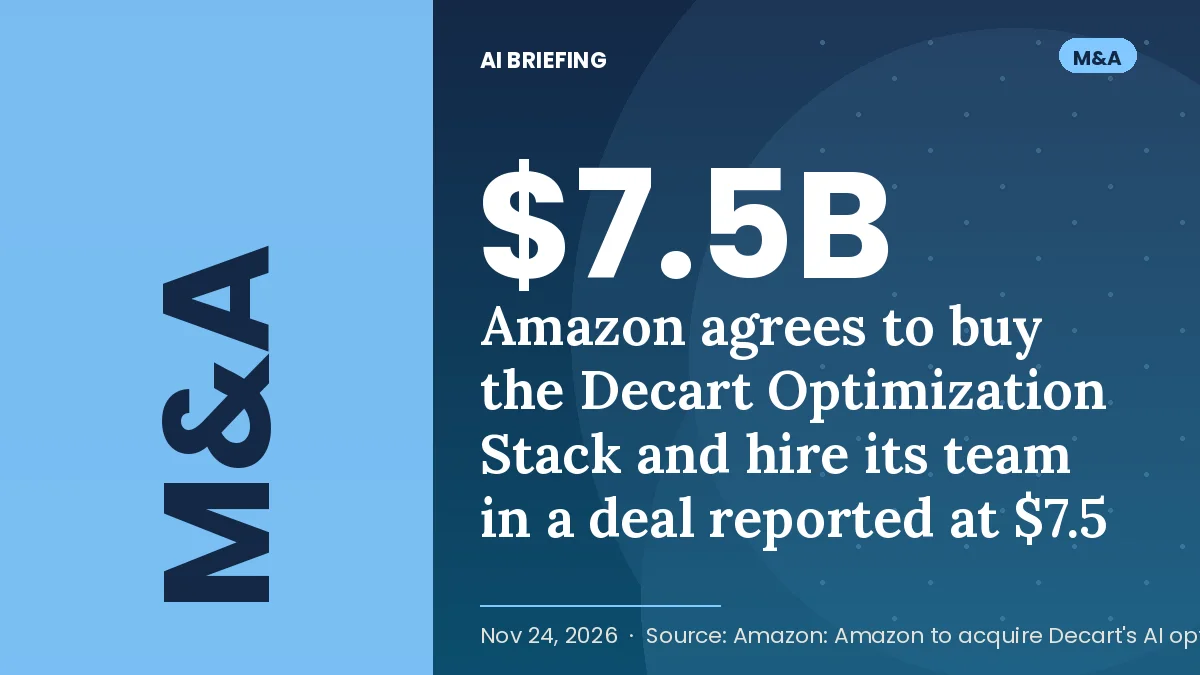
Amazon agrees to buy the Decart Optimization Stack and hire its team in a deal reported at $7.5 billion, its chip unit's bet on selling Trainium outside AWS; the NYT reports SpaceX is renting Colossus capacity to Anthropic and Google because Musk judged it more lucrative than competing

Amazon's statement describes a purchase of Decart's proprietary optimisation technology plus the move of co-founders Dean Leitersdorf, Moshe Shalev and Orian Leitersdorf and their researchers to Amazon, subject to regulatory clearance, with no price; Bloomberg put it at about $7.5 billion and GeekWire, citing Israeli reports, says it runs through Annapurna Labs with milestone payments over five years and leaves Decart's video models out. Amazon has worked with Decart on Trainium performance since 2025 and says the goal is faster, cheaper training and inference on its own silicon, which Andy Jassy expects to sell externally as a significant business. Separately the New York Times reported that Musk told SpaceX staff in August the company could not compete in AI and renamed an engineering chat 'Sell compute because we can't compete'; Anthropic's prospectus shows it reserving all of Colossus 1 at up to $3.1 billion a month once fully delivered, and Google contracted about 110,000 GPUs from June.

FinanceAmazon is paying up for software that makes its chips competitive, not for a model company; the Trainium external-sales thesis is now a line item. SpaceX's AI unit reportedly booked $7.6 billion in Q3, over half its revenue, from renting compute.
ML engineersDOS reportedly delivered 101 frames a second on Trainium versus 26 on GPU for Decart's video models; kernel-level optimisation is where custom silicon wins or loses.
ExecutivesIf Trainium becomes a sold product, cloud-independent accelerator supply gets a third source beside Nvidia and AMD.
DevelopersDecart's Lucy and Oasis models are not part of the deal; check your dependencies if you build on them.

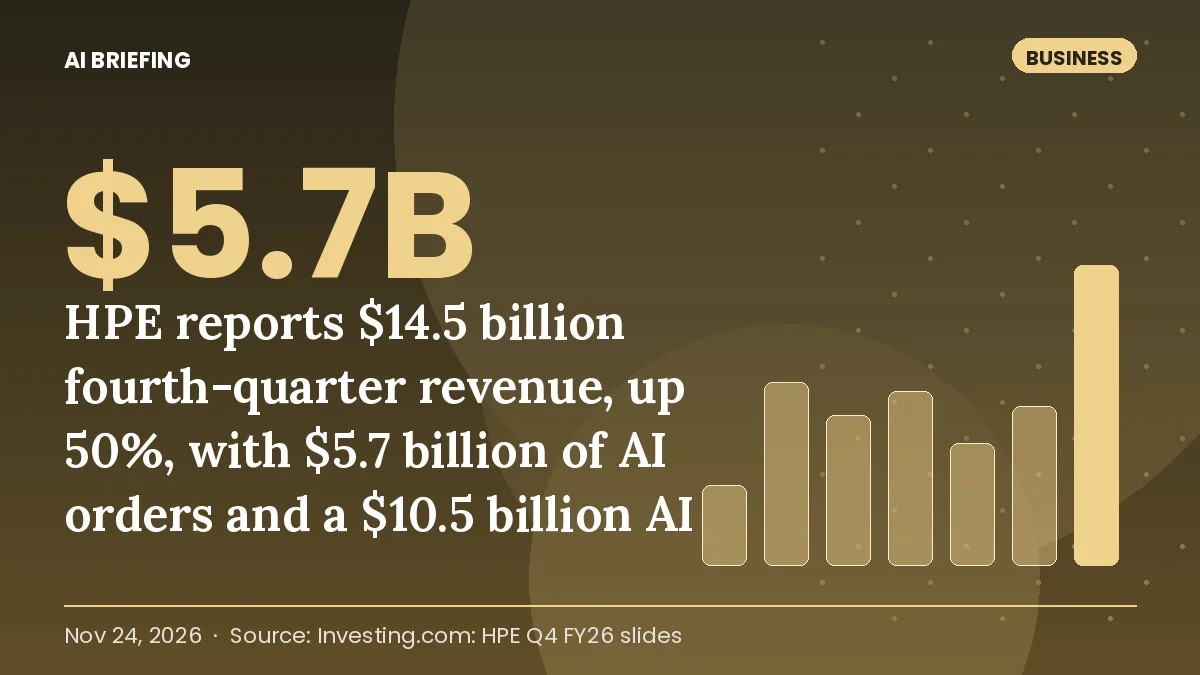
DevelopingHPE reports $14.5 billion fourth-quarter revenue, up 50%, with $5.7 billion of AI orders and a $10.5 billion AI backlog; CEO Antonio Neri says memory and NAND stay constrained through at least the second half of 2028; shares +17% then −7% after hours

Cloud & AI revenue rose 69% to $11.3 billion and orders grew 88% in the quarter, but gross margin slipped 220 basis points from the prior quarter and the Cloud & AI margin is guided to about 14% for fiscal 2027 as AI server mix rises and component costs outrun pricing. Full-year revenue was a record $46.7 billion with free cash flow of $4.5 billion, and the fiscal 2027 guide is 27–35% growth. Management did not address the reported repricing of signed contracts directly; the Juniper synergy target rose to $800 million. Dell reports on Tuesday evening.

FinanceVolume up, unit margins down, and a two-year supply constraint from the CEO: model AI servers as a pass-through business.
ExecutivesAny hardware plan assuming memory relief in 2027 is out of date; budget for increases through 2028.
DevelopersBacklog, not list price, decides delivery. Keep the cloud fallback warm.
SecurityScarcity pushes buyers to grey-market memory and refurbished accelerators; add firmware provenance to procurement.

Z.ai releases GLM-5.4, a roughly 750B 'Loop Transformer' that runs a 28-layer block twice per token, with image input and a 1M context, to Coding Plan subscribers only: no benchmarks, no API price and no weights yet

Z.ai converted the trained GLM-5 base through continued training rather than pretraining a looped model, with per-token gates controlling the second pass and the pass reusing the first pass's KV cache; it claims capability comparable to models of two to three trillion parameters but has published only a 30B ablation showing eight to eleven points of gain on maths and science for about 10% more compute. The release follows Thinking Machines' Inkling 2 Mini, which loops its middle layers three times to fit in 20 GB. An API is promised after safety evaluation and weights after hardening, without dates; GLM-5.3 stays the API model at $1.40 / $4.40.

ML engineersA conversion recipe for an existing checkpoint, not a new pretraining run; the 30B ablation is the only public evidence so far.
Developersglm-5.4 in ZCode and Z.ai Chat, glm-5.4[1m] in Claude Code; 50% more weekly quota than 5.3; watch for marathon thinking.
FinanceLooping spends FLOPs to save memory, which is the constrained input; whether it is passed through in price is the open question.
BeginnersThe model reads its own draft a second time with the same brain, instead of growing a bigger one.

Google DeepMind uses teams of Gemini 4 agents and Lean 4 proofs to find quantum algorithms with formally verified correctness, cutting the computing cost of a fusion simulation 11.8x and a state-preparation routine 290x

Each problem got an independent team of agents whose proposals were checked in Lean before entering a shared notebook, with teams exchanging ideas every four hours; every result is a proved Hoare triple with resource bounds, checked by an independent comparator against frozen specifications, because the circuits cannot be tested classically or on current hardware. The blog reports the inertial-confinement-fusion computation falling from 5,650 to 4,338 error-corrected qubits, a photochemistry problem 8x cheaper and a cytochrome P450 simulation 2.5x, with the Lean library and solutions open-sourced; the optimised circuits still exceed what the first error-corrected machines will offer.

ML engineersFormal verification as the reward signal for agent search: the same pattern as last week's Riemann claim, applied where empirical testing is impossible.
DevelopersThe Lean quantum library is on GitHub; it is a worked example of agents writing against a specification they cannot fake.
ExecutivesQuantum advantage timelines move with constant factors like these as much as with qubit counts.
BeginnersThe AI did not run a quantum computer; it found shorter recipes and proved, mathematically, that they are correct.

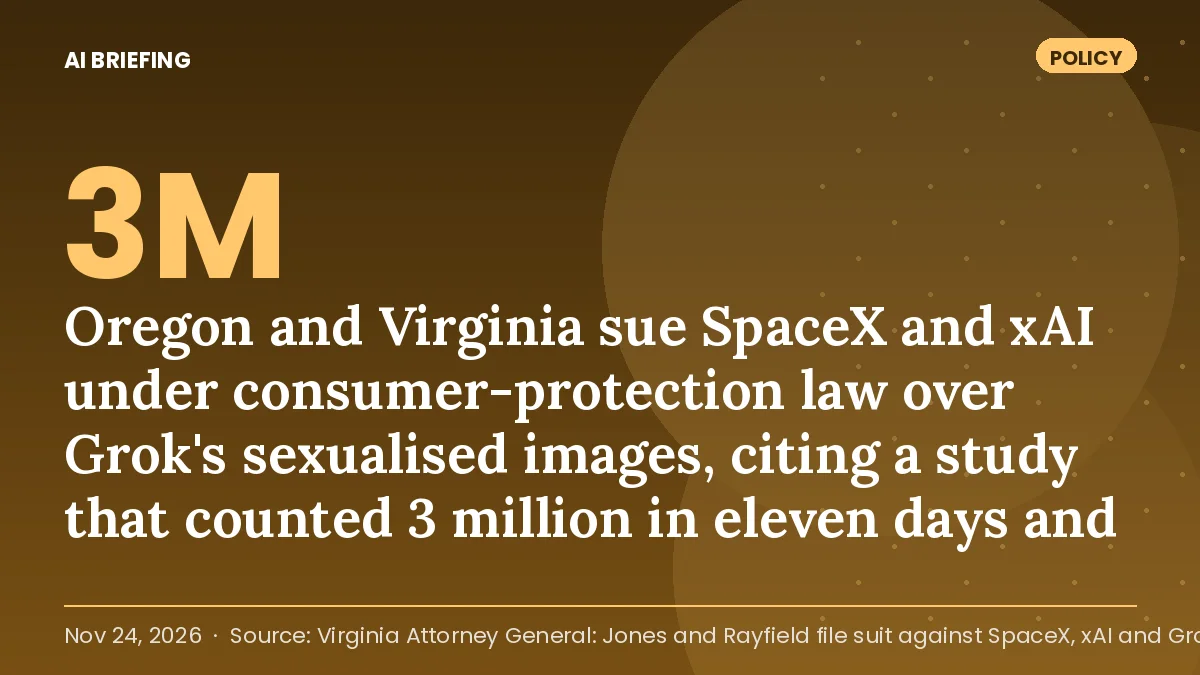
DevelopingOregon and Virginia sue SpaceX and xAI under consumer-protection law over Grok's sexualised images, citing a study that counted 3 million in eleven days and about 23,000 apparently of children; Virginia seeks up to $2,500 per wilful violation

Virginia filed in Richmond under its Consumer Protection Act and Oregon in Multnomah County under its Unlawful Trade Practices Act, arguing the companies marketed Grok as safe while promoting a 'spicy' mode that made abuse easy; neither brings criminal charges. The complaints cite the Center for Countering Digital Hate's count from late December to early January and more than 135,000 NCMEC reports from xAI and X since September 2025, over 90% initially unusable. SpaceX says such content is prohibited, safeguards have been strengthened and users circumvented restrictions.

ExecutivesMarketing copy is now evidence: write safety claims as if for a regulator.
SecurityThe quality of your NCMEC or abuse reporting is a litigable fact; audit it.
FinancePer-violation penalties at these volumes mean a consent decree with design obligations is the likely endpoint, not a trial.
BeginnersThe states are not prosecuting anyone; they are suing the companies for selling an unsafe product under false claims.

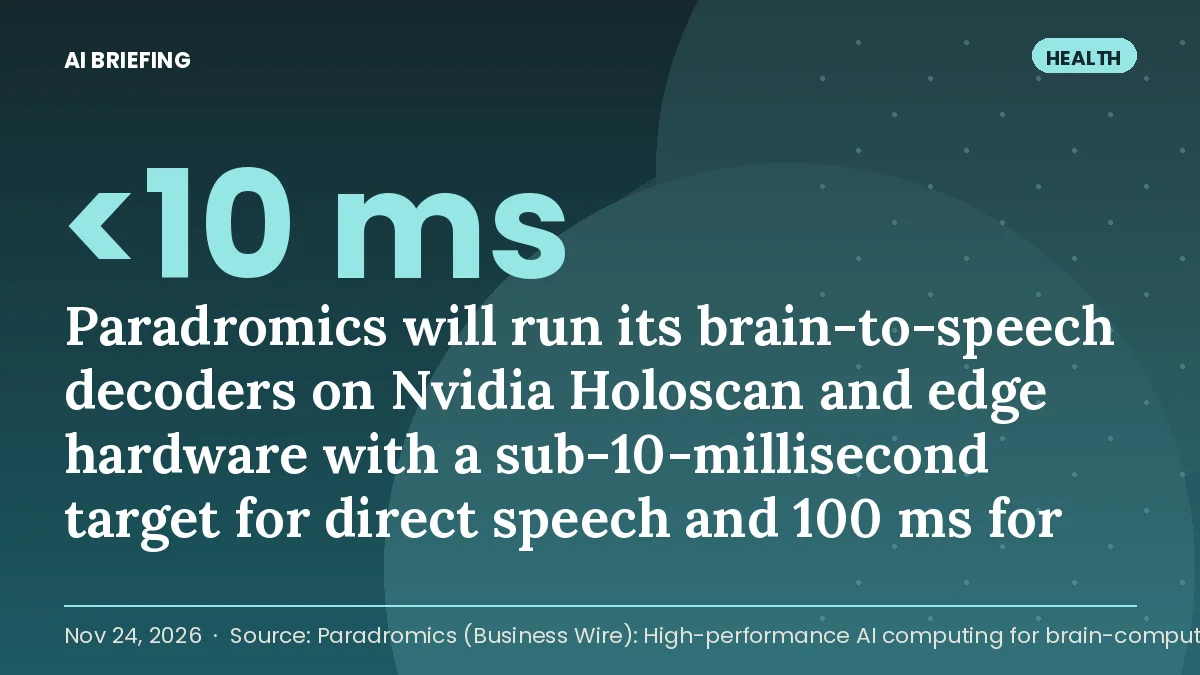
Paradromics will run its brain-to-speech decoders on Nvidia Holoscan and edge hardware with a sub-10-millisecond target for direct speech and 100 ms for text-first pipelines; the Connexus implant remains in an FDA-approved early feasibility study

The Austin company's 2026 roadmap ports speech decoding and synthesis to Holoscan, profiles power, and ships Nvidia IGX systems to academic partners in its APEX programme; 2027 adds motor control and vision-language-action models, with the long-term goal of a wearable external computer. Online fine-tuning is meant to recalibrate the decoder in the background as neural signals drift. No financial terms were disclosed, Nvidia issued no separate release, and the first participant's phone call with her grandchildren, reported in September, remains the only published outcome.

ML engineersSub-10 ms compute budgets and continual recalibration on a medical device: a real-time systems problem more than a decoding-accuracy one.
ExecutivesNvidia's medical edge stack becomes the standard environment for Paradromics' research partners; platforms win in devices by being where the data is.
FinanceInvestigational device, early feasibility study, no revenue; compare with Synchron's 2025 Holoscan work and Neuralink.
BeginnersThe implant reads the signals of attempted speech; the goal is to turn them into a voice fast enough to feel like talking.

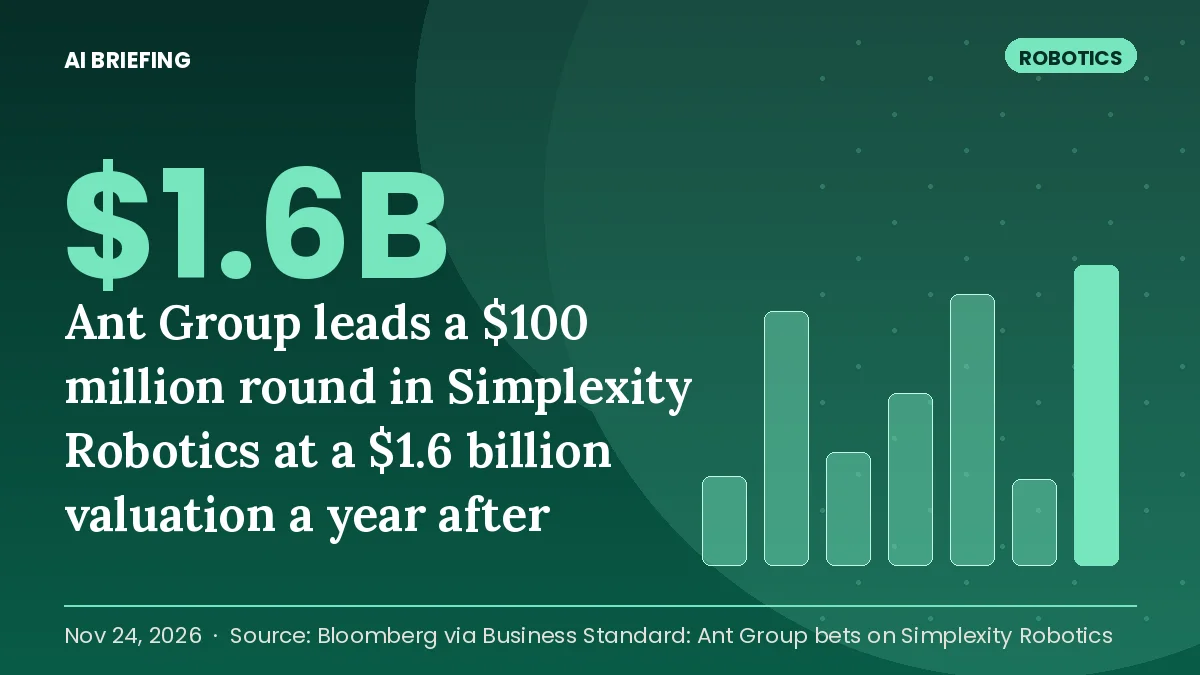
DevelopingAnt Group leads a $100 million round in Simplexity Robotics at a $1.6 billion valuation a year after founding; Zoox starts driverless rides in Los Angeles for employees only; Waymo files two NHTSA recalls with its freeway suspension still in force

Simplexity, founded by three ex-Li Auto executives, sells a wheeled humanoid that runs CNC machines to customers including a Tesla and Figure supplier, and showed a service robot called iX on Monday; Bloomberg notes Chinese firms shipped 97% of humanoids in the first three quarters of 2026 and the NDRC has warned of a bubble. Zoox's Santa Monica launch is its fifth market, with public riders deferred to 2027. Waymo's recalls cover driving in closed freeway lanes, remedy still in development, and response to manual traffic direction, already updated; it also paused Bay Area service for storms through Thanksgiving week.

FinanceA unicorn valuation on a pre-Series A inside a year, in a sector its own government calls frothy.
ExecutivesTask-specific wheeled humanoids are reaching factories before general-purpose legged ones.
ML engineersBoth Waymo recalls are perception-to-policy failures in edge cases, not sensor faults.
BeginnersDriverless in Los Angeles currently means Zoox staff and their families; public rides come later.
10 stories · 23 sources linked · summaries written in our own words and checked against the linked reporting · corrections: corrections@aibriefing.io

← Nov 23, 2026

Get the brief in your inbox

One email every morning: the stories that mattered in AI, each with a one-line "why it matters" for your role. Free, no ads, unsubscribe any time.

Published daily by AI Briefing. We never share your address.
Like this? Get tomorrow's brief by email, free.