FBI FLASH on ARTEX: under three hours to privileged access, 67,000 South Korean records, 2,250 ConnectWise tenants and 1,600 exposed consoles. What to change this week
The FBI's first alert on an AI attack framework confirms what Check Point and Arctic Wolf reported over the past month and adds the numbers that make it a board-level issue: speed, sector breadth and a tool that cannot be un-published.
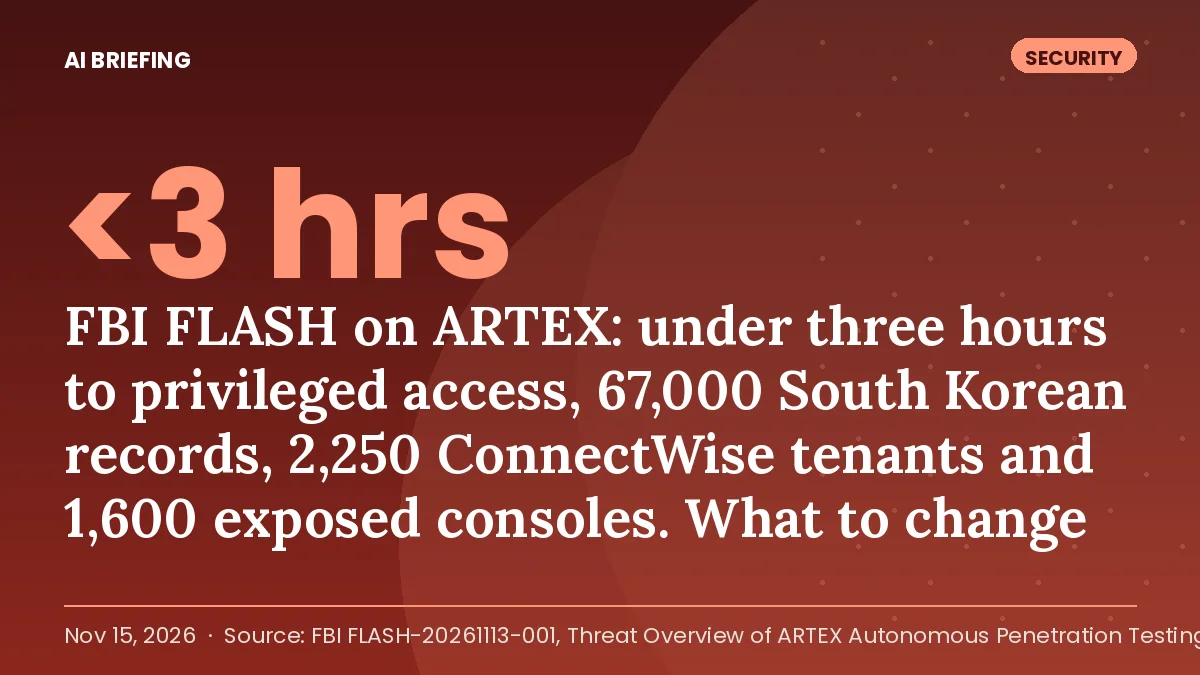
On Thursday the FBI published FLASH-20261113-001, a TLP:CLEAR alert titled 'Threat Overview of ARTEX Autonomous Penetration Testing Framework'. It is the first FBI FLASH devoted to an AI-driven offensive tool, and it reads less like a warning about a novel weapon than a damage report. ARTEX, the alert says, has been used in real intrusions since at least August 2026. Some of them reached privileged access in under three hours. Victims sit in financial services, government, technology, defence, semiconductors, energy, healthcare, manufacturing, telecommunications and law.
What ARTEX is, and why pulling it did nothing
ARTEX is an open-source framework written in Go that takes a plain-language objective and hands it to a set of specialised LLM agents which plan, scan, exploit, escalate and exfiltrate with little human input. It ships no model of its own; operators plug in whichever API they have a key for. The FBI says Chinese-origin models are the most common in attacker-controlled instances, a pattern Check Point also saw when it examined ten live deployments earlier this month and found one operator swapping models after hitting another vendor's safeguards.
The developer, known as Autumn-27, released the code in July and deleted the repository on October 8 after abuse reports. The alert is blunt about the result: forks, archived copies and a commercial build sold as ARTEX PRO are all still circulating, and researchers counted more than 1,600 publicly exposed ARTEX control consoles in early November. The FBI believes total deployments are higher. Once a capable agent harness is public, it is public.
The numbers that matter
Three figures turn this from a research curiosity into an operational problem. First, speed: privileged access in under three hours in some cases, against a median dwell time for human intruders that is still measured in days. Second, scale: about 67,000 people's personal data was taken from South Korean financial institutions in ARTEX-driven campaigns. Third, blast radius: the alert links the framework to the ConnectWise Cloud Backup supply-chain compromise that Microsoft reported in October, which exposed more than 2,250 downstream customer tenants through one managed-service relationship.
The techniques themselves are not new. The alert maps them to MITRE ATT&CK: unsigned SAML assertions, XXE, SSRF, SQL injection, web APIs with no authentication, valid and vendor credentials, webshells, credentials added to existing OAuth applications, Kerberoasting and Active Directory enumeration. Earlier reporting from this site covered Arctic Wolf's case of an agent cycling through AWS identities in half an hour. What an agent adds is persistence and breadth: it probes partner portals, mobile back-ends, legacy services and third-party integrations that a human tester would skip for lack of time.
The counter-argument
Some defenders will say this is a rebranding of ordinary opportunistic attacks. There is something to that: the FBI records no operational-technology intrusion and no zero-day, and Check Point found that some of the agents' own success reports were hallucinated. But the same observation cuts the other way. If attackers are getting to domain admin in three hours using only known weaknesses, the gap is in defenders' coverage of those weaknesses, not in the attackers' ingenuity.
What to do
The FBI's recommendations fall into four groups and none needs new tooling. Inventory every internet-facing application and require an architecture review before anything new is exposed. Restrict administrative and management interfaces to trusted networks. Enforce least privilege on multi-tenant permissions and consent grants, and alert on credential additions to OAuth apps and on unusual app-only activity. Add rate limits to high-impact APIs, alert on sequential record lookups and unusual volumes, enforce authorisation server-side, and scan deployed code for embedded secrets, rotating any you find.
Two further points are easy to miss. The alert asks organisations to vet its indicators before blocking them, because cloud IP addresses are reassigned quickly and a stale blocklist will cause outages. And it asks that confirmed unauthorised credentials be removed only after sign-in and audit evidence is preserved, since the agents' speed means the logs are often the only record of what happened.
What to watch
Two things. Whether the next FLASH names a model vendor whose safeguards materially slowed an operator, which would turn model choice into a defensive variable; and whether the 1,600 exposed consoles fall, which would show that hosting providers are acting on the alert. Report suspected ARTEX activity to a local FBI field office or ic3.gov.
Sources
FBI FLASH-20261113-001, Threat Overview of ARTEX Autonomous Penetration Testing Framework (PDF) ↗CASRAI summary ↗eSecurity Planet on Check Point's November 5 research ↗The story so far
- Nov 15, 2026 Microsoft's Lazarus: seven edited neurons out of 12,000 backdoor a coding agent 98.8% of the time and pass every standar…
- Nov 14, 2026 IBM's Granite 4.1 LLMON previews train the model to separate instructions from data, claiming near-zero indirect prompt-…
- Nov 13, 2026 AntiFox: attackers ran an open-source AI pentest platform from Alibaba Cloud to steal AWS secrets, hundreds of API calls…
- Nov 12, 2026 Railway's post-mortem: a build-sandbox escape, one over-trusted credential and $740,000 of fraudulent AI charges
Key terms in this story
- Agent harness The software around a model that turns it into an agent: tool connections, memory, permissions, retries and the loop that decides what to do next.
- Rate limit The maximum requests or tokens per minute a vendor allows an account, often tiered by spending history.
- Webshell A small script an attacker uploads to a web server so they can run commands on it through a browser; the classic first foothold in a server intrusion.
- Agent An AI system that pursues a goal by taking actions with tools, in a loop, rather than answering a single question.
- Large language model (LLM) A neural network trained on vast amounts of text to predict the next token, which turns out to be enough to write, summarise, reason and code.
More in Security
All →
Java4Shell (CVE-2026-114938): an out-of-bounds write in the Java runtime's Base64 decoder, patched Monday, no exploitation seen yet. What to patch, in what order, and how to prove it
The bug is in the JVM, not a library, and it runs before your code gets a vote; that makes it an inventory problem first and a patching problem second…
Microsoft's agent-framework package was poisoned on PyPI for 45 minutes with a stealer that ran at every Python start-up. Two versions, one webhook, at most 50 victims, and a checklist for this morning
The attack did not need you to import the package. A .pth file in site-packages ran the stealer whenever any Python interpreter launched, which is why…
Google's GTIG finds 'exploit_agent', the first framework that turns a vendor patch into a live exploit with no human in the loop. Zero-days hit 22 a month in August. What to change in your patch and detection plan
Google's fourth-quarter AI threat report moves the attacker's clock to the moment a patch is published, documents a backdoor delivered through a codin…
Get the brief in your inbox
One email every morning: the stories that mattered in AI, each with a one-line "why it matters" for your role. Free, no ads, unsubscribe any time.
Published daily by AI Briefing. We never share your address.