ARTEX inside AWS: anonymous S3 reads, CloudWatch log hunting with stolen keys and self-registration on open Cognito pools. What Datadog's and Check Point's telemetry shows and the ten user-agents to hunt for
The FBI's alert on Friday said what ARTEX is; the two vendor reports that preceded it say what it does once it has a foothold in a cloud account, and the pattern is noisy enough to detect if you are logging the right things.
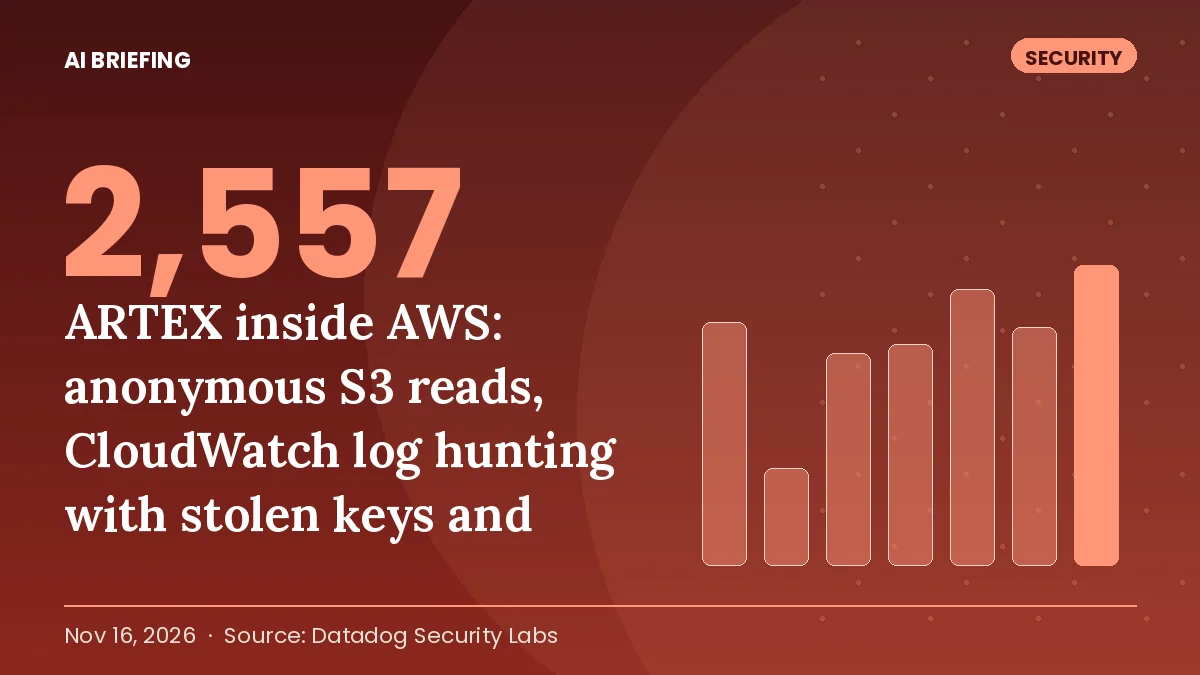
The FBI's FLASH alert on Friday described ARTEX as a framework that chains language-model agents from reconnaissance to exfiltration and said intrusions have reached privileged access in under three hours. Two vendor reports published in the previous week describe the mechanics, and together they give defenders something the alert does not: a sequence of cloud API calls to look for. Datadog Security Labs analysed ARTEX activity against AWS environments in October, and Check Point Research examined the exposed operator consoles themselves.
What the consoles reveal
Check Point counted 2,557 systems that hosted or had hosted ARTEX panels, 1,608 of them live and reachable, and found ten so badly misconfigured that their full databases were exposed, including prompts, model choices and every agent step. Chinese-origin models dominated, with the DeepSeek Flash family most common and US models configured on only three instances; the single guardrail trigger it observed came from Anthropic's Opus 5.5, after which the operator moved to a more permissive model. Goals were opportunistic and financial: cryptocurrency theft, code-signing certificates and gaming accounts taken from grey-market infrastructure, and denial-of-service against gambling sites. Most attacks ran almost fully autonomously once an operator set a goal. Datadog adds the plumbing: a planner dispatches intents to workers, three at a time by default, every action is recorded on a shared graph, and the framework speaks three API formats, OpenAI chat completions, OpenAI Responses and Anthropic Messages, so that when one provider revokes a key the campaign continues on another. Some builds exclude .gov and .edu domains by default. The developer closed the source on October 8 after the project passed 12,000 forks.
The AWS sequence
Every session Datadog reviewed began with unauthenticated S3 reads, visible in CloudTrail as an anonymous account ID with a user-identity type of AWSAccount. The agent pulls front-end assets to find build manifests and runtime configuration, and probes with deliberately nonexistent object names to learn what a not-found response looks like before fuzzing. Two clusters followed. In the first, a compromised long-term access key was used to call CloudWatch FilterLogEvents with a limit of 1,000, searching logs for the names of crypto companies, hedge funds and banks combined with terms such as Fund, Invoice, Billing and LLC; by October 20 the same key, now used from an IP tied to a Chinese domain, was searching for presigned S3 links, document files, internal IPs, database references, secrets and AKIA key prefixes. In the second, on October 26 and 27, the agent self-registered on public Cognito user pools, some requests carrying the user-agent Mozilla/5.0 ARTeX, kept probing after a pre-signup Lambda rejected its domain, completed the standard token flow, exchanged tokens for short-term AWS credentials and then attempted almost every read-only discovery call in the SDK, from ListBuckets to DescribeLogGroups. All of those failed because the authenticated role had no permissions, which is the point: a correctly scoped role turned a breach into a log entry. Datadog published ten user-agent strings, among them artex-readonly/1.0, artex-pentest/1.0, artex-audit/1.0 and ARTEX-worker/1.0, and ten IP addresses, with the caveat that user-agents are trivial to change.
The counter-argument
None of this is novel tradecraft. Anonymous bucket reads, leaked keys and open sign-up flows have filled cloud pentest reports for a decade. What the reports document is tempo and breadth: an agent tries every discovery call rather than the ones a human remembers, works three tasks in parallel and does not stop at a refusal. That argues for detection on volume and sequence rather than on any single signature.
What to do
Hunt CloudTrail for the published user-agents and IPs, then for the pattern: anonymous S3 GetObject bursts, a long-term key calling FilterLogEvents across regions, and Cognito SignUp from unfamiliar ranges followed by GetCredentialsForIdentity. Alert on spikes of AccessDenied for one principal and on enumeration from a new principal or from a key used outside AWS address space. Rotate or remove long-lived access keys and deactivate anything unused; the key in Datadog's first cluster was still valid weeks into the campaign. Audit every Cognito pool for open self-registration and read the authenticated role's policy line by line. And remove public access to any bucket that holds build artefacts, because the agent's first move is to read them.
Sources
Datadog Security Labs ↗Check Point Research summary via Let's Data Science ↗FBI FLASH-20261113-001 (PDF) ↗The story so far
- Nov 16, 2026 'National champions' and a Shenzhen summit: the US plans to package Nvidia, OpenAI, Anthropic, Microsoft and Amazon for …
- Nov 15, 2026 FBI FLASH on ARTEX: under three hours to privileged access, 67,000 South Korean records, 2,250 ConnectWise tenants and 1…
- Nov 15, 2026 Microsoft's Lazarus: seven edited neurons out of 12,000 backdoor a coding agent 98.8% of the time and pass every standar…
- Nov 14, 2026 IBM's Granite 4.1 LLMON previews train the model to separate instructions from data, claiming near-zero indirect prompt-…
Key terms in this story
- Token The unit models read and write; roughly three-quarters of an English word. Pricing and context limits are counted in tokens.
- Agent An AI system that pursues a goal by taking actions with tools, in a loop, rather than answering a single question.
More in Security
All →
Java4Shell (CVE-2026-114938): an out-of-bounds write in the Java runtime's Base64 decoder, patched Monday, no exploitation seen yet. What to patch, in what order, and how to prove it
The bug is in the JVM, not a library, and it runs before your code gets a vote; that makes it an inventory problem first and a patching problem second…
Microsoft's agent-framework package was poisoned on PyPI for 45 minutes with a stealer that ran at every Python start-up. Two versions, one webhook, at most 50 victims, and a checklist for this morning
The attack did not need you to import the package. A .pth file in site-packages ran the stealer whenever any Python interpreter launched, which is why…
Google's GTIG finds 'exploit_agent', the first framework that turns a vendor patch into a live exploit with no human in the loop. Zero-days hit 22 a month in August. What to change in your patch and detection plan
Google's fourth-quarter AI threat report moves the attacker's clock to the moment a patch is published, documents a backdoor delivered through a codin…
Get the brief in your inbox
One email every morning: the stories that mattered in AI, each with a one-line "why it matters" for your role. Free, no ads, unsubscribe any time.
Published daily by AI Briefing. We never share your address.