DevelopingTesla starts rolling out FSD v15 with a '25x better' safety claim and no baseline, the same weekend Waymo pulls its robotaxis off freeways nationwide. What the numbers do and do not show
One company shipped a new vision encoder shared with its humanoid and declared the singularity; the other accepted a California order after construction-zone incidents. Only one of them published a method.
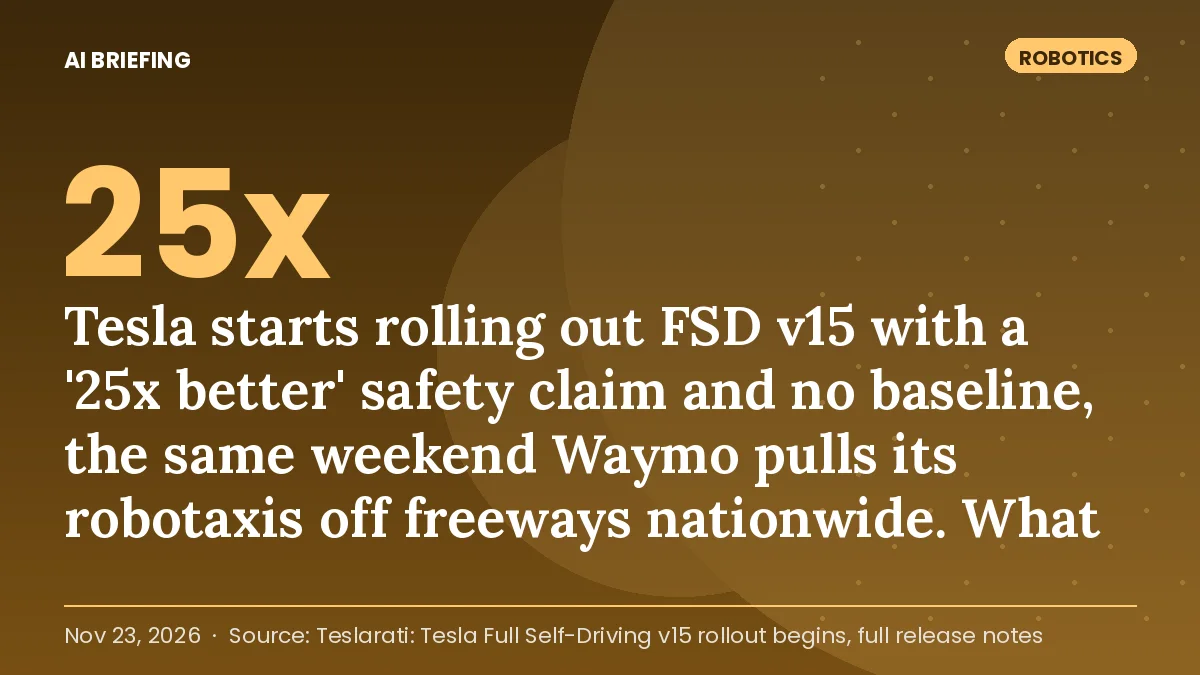
Tesla began pushing Full Self-Driving version 15 to early-access owners on Saturday, with Elon Musk promising a wide release in December's holiday update. The release notes describe a new shared vision encoder, trained on internet video and used across the consumer cars, the Robotaxi fleet and the Optimus humanoid; a generative overhead rendering Tesla calls Reality View; end-to-end learned handling of the start and end of trips; parking that remembers your usual spot; and better detection of signs, small animals, debris, potholes and standing water. Initial availability is on the redesigned Model Y; older HW3 cars are excluded.
The claim
The line everyone repeated is Tesla's: 25x better handling of safety-critical cases. On Sunday Musk clarified that he meant twenty-five times, not twenty-five percent, and welcomed readers to the singularity. What neither Tesla nor Musk has published is the baseline. The notes do not say whether the comparison is against v14, against an earlier build, or against a fleet average; they give no mileage, no definition of a critical case and no methodology. Reports describing the figure as 25x versus v14 are inferring, not citing. A ratio with no denominator is marketing until the denominator appears, and Tesla's consumer product is not subject to the disengagement reporting that California requires of permitted autonomous testers.
The technically interesting part is the encoder. If one perception model now serves cars, robotaxis and a humanoid, then every mile the fleet drives becomes training signal for the robot, which is the argument Tesla has been making for Optimus for two years. Musk said on Friday that Optimus would give an unscripted demonstration within one to two months and on Sunday that the AI5 chip would go to Optimus before the cars. Those are checkable promises with dates.
Waymo's weekend
Waymo, meanwhile, pulled its robotaxis off freeways across every market it operates in after an order from California regulators, following incidents in construction zones and closed freeway lanes. The company said no collisions or injuries resulted from the closed-lane events and that a recall remedy is pending. Freeway service was the feature Waymo rolled out most recently, and taking it away everywhere rather than only in California suggests the fix is in software rather than in local mapping. Elsewhere in the same roundup: Zoox robotaxis are now bookable through Uber in Las Vegas, Tesla has 1,507 robotaxis registered in Texas against Waymo's 1,345, and Tesla has opened personal Cybercab pre-orders at $29,990 plus $299 a month.
The counter-argument
Tesla's defenders will say that a disengagement count is a poor safety metric too, that Waymo's own numbers are self-reported, and that a company shipping to hundreds of thousands of cars has data no regulator-permitted fleet of a few thousand can match. That is partly true. It is also why the absence of any published figure is the story: the fleet with the most data has chosen to release a multiplier and nothing else.
What to watch
Three things in the next six weeks. Whether Tesla's wide release in December comes with any definition of a critical intervention or any mileage figure; whether Waymo's recall filing with NHTSA describes the construction-zone failure and the remedy, which will tell you how long freeway service stays off; and whether the Optimus demonstration Musk promised happens on the timeline he gave. For robotics teams, the shared-encoder claim is the one to probe: if Tesla publishes anything on transfer from driving video to manipulation, it will be the most consequential robotics paper of the quarter.
Sources
Teslarati: Tesla Full Self-Driving v15 rollout begins, full release notes ↗CleanTechnica: Waymo pulls robotaxis from highways ↗TechCrunch Mobility: A/B testing robots vs humans ↗The story so far
- Nov 18, 2026 Genesis AI raises $500 million at $3.5 billion for a robot trained on glove data from 100 workers, and GlobalFoundries b…
- Nov 11, 2026 Skild AI's Steel runs robot simulation up to 13x faster than PhysX on mixed batches and uses 62% less memory; here is wh…
- Nov 10, 2026 Nvidia's GR00T 2 claims 71% one-shot success on 50 tasks. Here is what that number does and does not say
More in Robotics
All →
Genesis AI raises $500 million at $3.5 billion for a robot trained on glove data from 100 workers, and GlobalFoundries becomes Atlas's first non-automotive tester. Two routes into the factory, priced very differently
One company is being valued on how it collects hand data before it has customers; the other is earning a humanoid pilot after 90,000 inspections by a …
Open-weight robot brains on both sides of the Pacific: Huawei's CloudRobo-WM1.2 on Ascend, Runway's Praxis-1 at 46.2% on RoboLab-120, and Agile Robots' $8.5 billion without a shipment figure
In one week the two most capable open world-action models for robots arrived from a video-generation company in New York and a chip company in Shenzhe…
GXO's plan for up to 1,000 Apptronik Apollo humanoids over four years: what a robots-as-a-service letter of intent actually commits to, and what it does not
The largest pure-play contract logistics company has signed the biggest humanoid framework yet, but it is stepped, KPI-gated and paid per robot-hour; …
Get the brief in your inbox
One email every morning: the stories that mattered in AI, each with a one-line "why it matters" for your role. Free, no ads, unsubscribe any time.
Published daily by AI Briefing. We never share your address.