Claude Fable 5.2 cuts the top tier to $8 / $40: what actually changes for buyers
Anthropic's flagship is 20% cheaper and, on its own numbers, far better at agentic coding, but the company still tells most customers to stay on Opus 5.5.
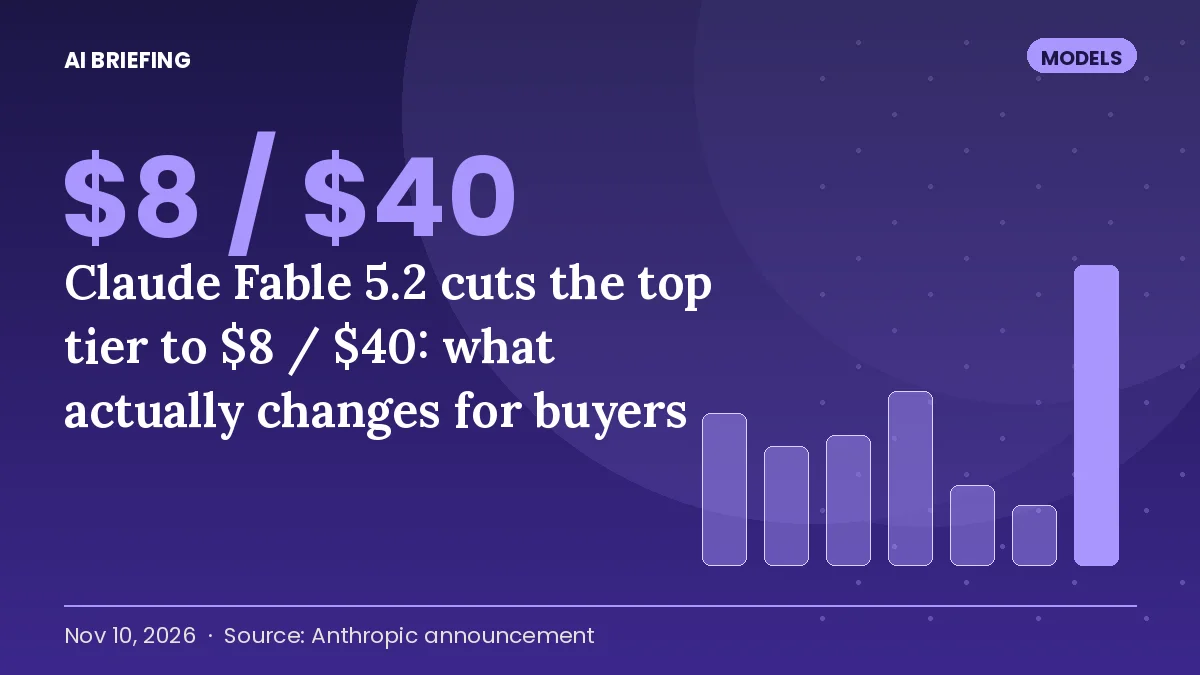
Anthropic released Claude Fable 5.2 and Claude Mythos 5.2 on November 9 and, for the first time in the Mythos-class line, cut the price. Both list at $8 per million input tokens and $40 per million output tokens, down from $10 / $50 for the 5.1 models launched in September. Cached input reads cost $0.20, batch requests are half price at $4 / $20, and a new fast mode that Anthropic says generates tokens up to 2.5 times faster costs double, $16 / $80.
What is new
Fable and Mythos remain one underlying model. Fable carries additional safeguards for cyber and biology tasks and is available to everyone on the Claude API, AWS, Google Cloud and Microsoft Azure. Mythos drops those safeguards and is reserved for organisations vetted through Anthropic's cyber and life-sciences verification programmes, though Claude Enterprise customers can use its vulnerability-detection capability through the Claude Security product without joining either.
On Anthropic's published tables, Fable 5.2 scores 49.1% on FrontierCode 2.0 at its highest effort setting, against 32.4% for Fable 5.1 and 45.5% for Opus 5.5. It posts 69.9% on FrontierSWE v2, 89.3% on OSWorld 2.1 and 41.3% on the Remote Labor Index, more than double 5.1's 17.9%. Anthropic also says outputs are up to 30% faster across effort levels and that at the default Medium effort the model finishes tasks with fewer tokens than 5.1 did.
The claim most relevant to buyers is a cost one: Anthropic says Fable 5.2 at High effort roughly matches Opus 5.5 at Max on FrontierCode (45.3% versus 45.5%) at about half the cost per task. If that holds on your workload, the top tier stops being a luxury for a handful of jobs.
The counter-argument
Every number above is Anthropic's own, and several of the showcase results, including the 30-hour Lean formalisation of Fermat's Last Theorem by roughly 1,000 agents, were single runs. Gemini 4 Carbon still leads Anthropic's own table on AutomationBench and Chartography, and Opus 5.5 edges Fable 5.2 on the AA-Briefcase Elo (1800 versus 1785). Analysts quoted by InfoWorld made the point that matters for budgets: Anthropic has cut the price of a token, not the price of a task, and agentic work at higher effort levels can consume many more tokens than a single prompt did a year ago.
There is also a data-handling wrinkle. Customers eligible for zero data retention keep it with the new models through the Enterprise Frontier Safeguards programme, which is still in private beta; everyone else accepts 30-day retention of prompts and outputs for safety monitoring. For regulated buyers that term can outweigh a 20% price cut, and procurement teams should get it in writing.
Where this leaves the price ladder
With this cut, OpenAI's GPT-6 Astra at $10 / $50 becomes the most expensive flagship in our pricing tracker, with GPT-6 Cyber at $20 / $100 above it as a gated special case. The mid-tier is now crowded at $2 / $10 (Sonnet 5.5, GPT-6.1 Sol, Gemini 4 Argon until November 30) and the budget tier sits at $0.10 / $0.50 (Haiku 5.5, GPT-6 Luna and, as of this week, Meta's Muse Ember). Anthropic's own recommendation is unchanged: Opus 5.5 for most coding and knowledge work, Fable or Mythos for the hardest open-ended tasks.
What to do
Pick three workloads where Opus 5.5 currently fails or needs heavy human review and run them on Fable 5.2 at High effort, measuring cost per completed task rather than per token. Check whether your account is eligible for zero data retention before routing anything sensitive. If you are on Fable 5.1, note that it still lists at $10 / $50; the saving only arrives when you change the model ID to claude-fable-5-2. And wait for independent evaluations, which usually arrive within a week of a release of this size, before making the switch permanent.
More in Models & research
All →
Inkling 2 Small: a 594B-parameter model trained in 68 hours, priced at $0.30 per million tokens
Thinking Machines' second-generation model is a case study in how cheap sparse pretraining has become, and a direct price attack on the mid-tier where…
SoftBank's $7 billion loss lands on the day Anthropic starts selling a $1.1–1.3 trillion IPO
The largest outside holder of OpenAI just reported its first quarterly loss in two years, and the valuation range for Anthropic's listing has fallen f…
Nvidia's GR00T 2 claims 71% one-shot success on 50 tasks. Here is what that number does and does not say
A new open world-action model trained on 100,000 hours of human video, a simulator that agents can configure themselves, and a benchmark claim that ne…
Get the brief in your inbox
One email every morning: the stories that mattered in AI, each with a one-line "why it matters" for your role. Free, no ads, unsubscribe any time.
Published daily by AI Briefing. We never share your address.